
Vol. 261 | 2025.12.16
| Category | Company | Article |
|---|---|---|
| ADAS | Volkswagen | Volkswagen Group begins real-world autonomous testing with its Gen.Urban research vehicle |
| LiDAR Sensor | Ouster | Is Ouster Evolving From LiDAR Hardware Vendor To Core Autonomy Platform Enabler? |
| Autonomous Trucking | Vale, Caterpillar | Vale confirms autonomous truck fleet expansion deal with Caterpillar |
| Autonomous Trucking | Uber, Lucid | Why did Uber choose the Lucid Gravity for its fleet of self-driving taxis? |
| Autonomous Trucking | Autonomous Truck | The global rise of autonomous trucks and last-mile delivery |

Volkswagen Group begins real-world autonomous testing with its Gen.Urban research vehicle
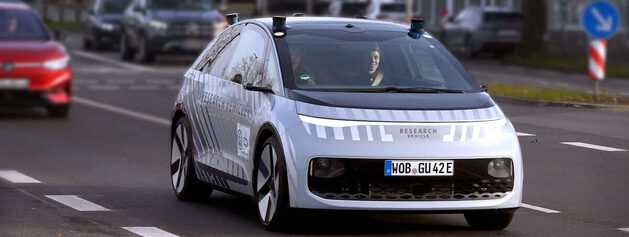
📌 Volkswagen Group has begun real-world urban testing of its Gen.Urban autonomous research vehicle in Wolfsburg, focusing on passenger experience and human-centric autonomous mobility.
-
Volkswagen Group launched a new phase of autonomous vehicle testing by deploying the Gen.Urban research vehicle in live urban traffic in Wolfsburg, Germany.
-
Gen.Urban operates without a steering wheel or pedals, serving as a pure research platform to study passenger behavior, comfort, and interaction in autonomous driving environments.
-
The test route covers a nearly 10-kilometer loop through real city conditions, including intersections, roundabouts, construction zones, and residential and industrial areas.
-
Each autonomous run lasts approximately 20 minutes and includes a trained safety driver in the passenger seat with joystick-based override capability.
-
Volkswagen’s interdisciplinary team collects data on passenger trust, comfort, activity preferences, and user interface expectations across different age groups.
-
Passengers can personalize cabin settings such as lighting, climate, sound, and seating through an app or in-vehicle interface before each journey.
-
An AI-driven front display adapts visuals, lighting, and sound in real time to enhance the personalized in-cabin experience.
-
Insights from the Wolfsburg trials will inform future autonomous vehicle UX design across Volkswagen Group brands, despite Gen.Urban not being a commercial product.

Is Ouster Evolving From LiDAR Hardware Vendor To Core Autonomy Platform Enabler?

📌 Recent coverage frames Ouster as a LiDAR-centric business expanding beyond hardware into a multi-end-market platform strategy across autonomy, smart infrastructure, and automation.
-
Recent coverage highlights Ouster’s role as a pure-play LiDAR provider serving autonomous vehicles, industrial automation, robotics, defense, and smart infrastructure markets.
-
Investor interest has increased as LiDAR gains recognition as a foundational sensing layer rather than a niche hardware component.
-
Analysts project strong year-over-year revenue growth, with estimates pointing to approximately 35% growth in the near term.
-
Ouster’s BlueCity Intelligent Transportation Systems solution, including a US$2 million Chattanooga contract covering 120 intersections, anchors its smart infrastructure growth narrative.
-
Real-world deployments test Ouster’s ability to scale LiDAR installations and convert early wins into repeatable software and services revenue.
-
The investment thesis assumes LiDAR adoption expands broadly across vehicles, infrastructure, and automation despite Ouster’s ongoing losses.
-
Competitive pressure from Chinese LiDAR manufacturers and legacy infrastructure technologies remains a key risk to margins.
-
Long-term projections forecast US$335.6 million in revenue and US$30.3 million in earnings by 2028, supporting a bullish valuation outlook.

Vale confirms autonomous truck fleet expansion deal with Caterpillar
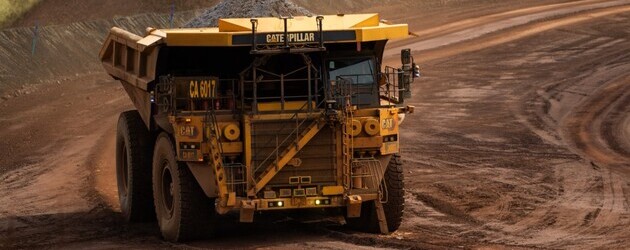
📌Vale, Caterpillar, and Sotreq will significantly expand autonomous haul truck deployments at Vale’s Carajás iron ore operations, accelerating productivity, safety, and sustainability through mixed-fleet autonomy.
-
Vale, Caterpillar, and Sotreq signed an agreement to expand autonomous haul truck operations in the Northern System at Carajás, Pará state, Brazil.
-
The deployment will scale over the next five years across Serra Norte (N4W, N4E, N5) and Serra Sul (S11D) iron ore mines.
-
The current fleet of 14 autonomous Komatsu trucks will expand to approximately 90 autonomous haul trucks in the region by 2028.
-
The expanded fleet will operate using Cat MineStar Command for hauling, including ultra-class trucks with up to 400-ton payload capacity.
-
The solution supports mixed fleets, enabling autonomy kits to retrofit both Caterpillar and competitor trucks and reducing upfront CAPEX.
-
Vale reports autonomous haulage can deliver up to 15% operational performance gains and up to 7.5% fuel consumption reduction.
-
Since 2019, Vale has trained more than 260 professionals to support new digital and autonomous mining roles.
-
Vale plans to grow its global autonomous truck fleet to more than 150 units within the next two years, reinforcing its smart mining strategy.

Why did Uber choose the Lucid Gravity for its fleet of self-driving taxis?

📌 Uber plans to deploy self-driving Lucid Gravity robotaxis in San Francisco, leveraging built-in vehicle redundancy and Nuro’s autonomous driving system to accelerate commercial rollout.
-
Uber is preparing to launch self-driving Lucid Gravity taxis in San Francisco starting next year as part of its expanding autonomous mobility strategy.
-
Uber has partnered with 18 companies globally and formed a three-way agreement with Lucid and Nuro to scale driverless ride-hailing services.
-
The deal includes deploying Nuro’s automated driving system on more than 20,000 Lucid vehicles and a US$300 million investment by Uber in Lucid.
-
Lucid Gravity was selected despite its premium price due to its redundant engineering architecture and integrated safety systems required for autonomous operation.
-
Autonomous taxi operations demand higher safety standards, including redundant steering, control units, and communication pathways, which Gravity provides out of the factory.
-
Lucid states that Gravity requires minimal hardware modification to support autonomous driving compared with vehicles needing extensive retrofitting.
-
The vehicle features Lucid’s advanced electrical and control architecture, enabling faster deployment timelines for robotaxi services.
-
While Gravity currently supports Level 2 DreamDrive Pro, Nuro supplies the higher-level autonomous driving technology required for fully driverless operation.

The global rise of autonomous trucks and last-mile deliv
📌 Level 4 autonomous trucks and last-mile delivery are moving rapidly from pilots to early commercial deployment worldwide, driven by structured routes, regulatory progress, and strong cost-reduction potential.
-
Level 4 transportation-as-a-service (TaaS) for autonomous trucks and last-mile delivery is scaling globally, with more than 40 companies active across Asia, Europe, the Middle East, and North America.
-
Autonomous trucking is advancing faster than robotaxis due to predictable highway corridors, enabling earlier deployment on routes such as Texas I-45, Arizona I-10, and German Autobahns.
-
Aurora launched the first fully driverless Class 8 trucking service on US public roads in 2025 and plans to expand routes to El Paso and Phoenix by year-end.
-
OEM and AV partnerships are accelerating, including SANY Group and Pony.ai’s platooning solution, which targets up to 29% cost reduction per kilometer and significant profit uplift.
-
Autonomous last-mile delivery is stabilizing around viable use cases such as campuses, controlled districts, and fixed B2B routes, with deployments by Nuro, Starship Technologies, and others.
-
Regulatory frameworks are progressing unevenly, with US federal bills, California’s proposed heavy-duty AV rules, Germany’s L4 law, and China’s smart-highway pilots shaping deployment paths.
-
Key challenges remain regulatory fragmentation, public trust, and emergency-response integration, while hub-to-hub freight corridors and yard-to-road autonomy present near-term scale opportunities.
* Contents above are the opinion of ChatGPT, not an individual nor company
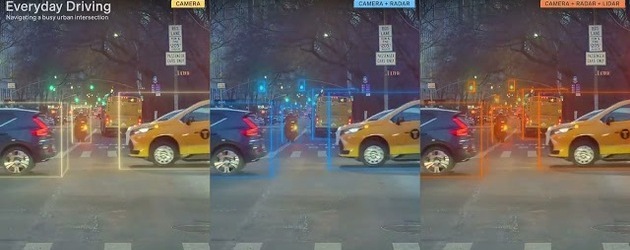
Rivian demonstrates the differences between Camera, Radar, and LiDAR