[Challenge Enterprise White Paper] The Future of Autonomous Driving Envisioned by Vueron Technology (Part 1)
Innovation in the “eyes” and the “brain,” the pinnacle of LiDAR technology
Overwhelming optimization and perception algorithms even on low-spec hardware
World’s first successful autonomous driving using LiDAR alone

As the battle for technological supremacy intensifies, the importance of fostering globally innovative companies is coming into sharper focus. Mid-sized companies, SMEs, startups, and venture firms that drive domestic industrial innovation are critical to securing the long-term competitiveness of Korean industry. Amid a global economy filled with uncertainty, we take a closer look at the growth paths and risks of Korean companies that shape the nation’s industrial innovation indicators and serve as engines of economic dynamism.
[Editor’s Note]
Kim Jae-kwang, CEO of Vueron Technology, founded the company with the ambition of “creating eyes and a brain that see and interpret the world on behalf of people.”
eoul = Hans Economy, Reporter Kim Jong-hyo — The global autonomous driving and artificial intelligence industry is increasingly turning its attention to Vueron Technology, a Korean company specializing in AI-based LiDAR perception solutions.
At CES 2026, held in Las Vegas in January, Vueron won an Innovation Award in the Vehicle Technology & Advanced Mobility category, once again proving its world-class technological competitiveness. At the exhibition, the company unveiled VueX, a solution that introduced the concept of a “foundry” to the LiDAR perception AI field for the first time, signaling its ambition to set the standard not only in the autonomous driving hardware market but also in the software platform market.
This achievement came at a time when the autonomous driving industry is locked in fierce competition between camera-based vision technology and LiDAR-based precision perception technology. Vueron has carved out a unique path by overcoming hardware limitations through software. Its perception algorithm, which converts the massive amount of coordinate data collected by LiDAR—the “eyes” of autonomous vehicles—into meaningful information, is now expanding beyond automobiles into smart cities, intelligent transportation systems (ITS), and industrial safety.
Opening an Era in Which Software Surpasses Hardware Limitations
The roots of Vueron Technology trace back to H-Startup, Hyundai Motor’s in-house startup incubation program. While working as an engineer at Hyundai Motor’s autonomous driving center, CEO Kim Jae-kwang recognized that software capable of interpreting LiDAR data was advancing far more slowly than LiDAR hardware itself.
LiDAR sensors emit lasers toward the surrounding environment and measure the time it takes for them to return, generating tens of thousands of data points known as a “point cloud.” However, the raw data alone cannot tell whether an object is a pedestrian, a utility pole, or a large truck in the adjacent lane.
Kim realized that software capable of breathing life into this “collection of points” and instantly identifying objects like the human brain would be the real battleground in autonomous driving. In 2019, he founded Vueron Technology with the ambition of “creating eyes and a brain that see and interpret the world on behalf of people.”
Vueron’s philosophy is clear: an obsession with technical perfection is what ultimately guarantees human safety. This belief has evolved into a mission to establish the standard for safety technologies that protect human life throughout society.

Overwhelming Embedded Optimization and Highly Versatile Perception Algorithms
The biggest reason Vueron Technology has been courted by global OEMs and Tier 1 suppliers is its overwhelming strength in embedded optimization.
While competing autonomous driving solution providers generally require high-performance GPUs and server-grade computing systems that consume large amounts of power, Vueron’s VueOne solution runs smoothly even on low-spec, low-power automotive chips such as MCUs. This is a key factor that can dramatically reduce manufacturing costs when applied to mass-produced vehicles, and it has helped the company build a meaningful business track record.
Vueron’s perception algorithm also boasts a high level of versatility, as it is not dependent on any specific hardware. Whether the customer uses products from major global LiDAR manufacturers such as Velodyne, Hesai, or Ouster, the algorithm can deliver the same high-performance perception results. This compatibility maximizes flexibility in hardware selection for customers and minimizes integration costs with existing systems.
To prove this technological edge, Vueron shocked the industry in 2021 by obtaining the world’s first temporary autonomous driving permit using only a single LiDAR sensor. At a time when most autonomous driving companies were focused on sensor fusion using cameras, radar, and LiDAR, Vueron chose the direct approach of LiDAR-only driving to demonstrate the power of its software. Its subsequent success in intervention-free autonomous driving between Seoul and Busan, followed by long-distance intervention-free driving in California, signaled that Vueron’s technology had reached the highest global level.
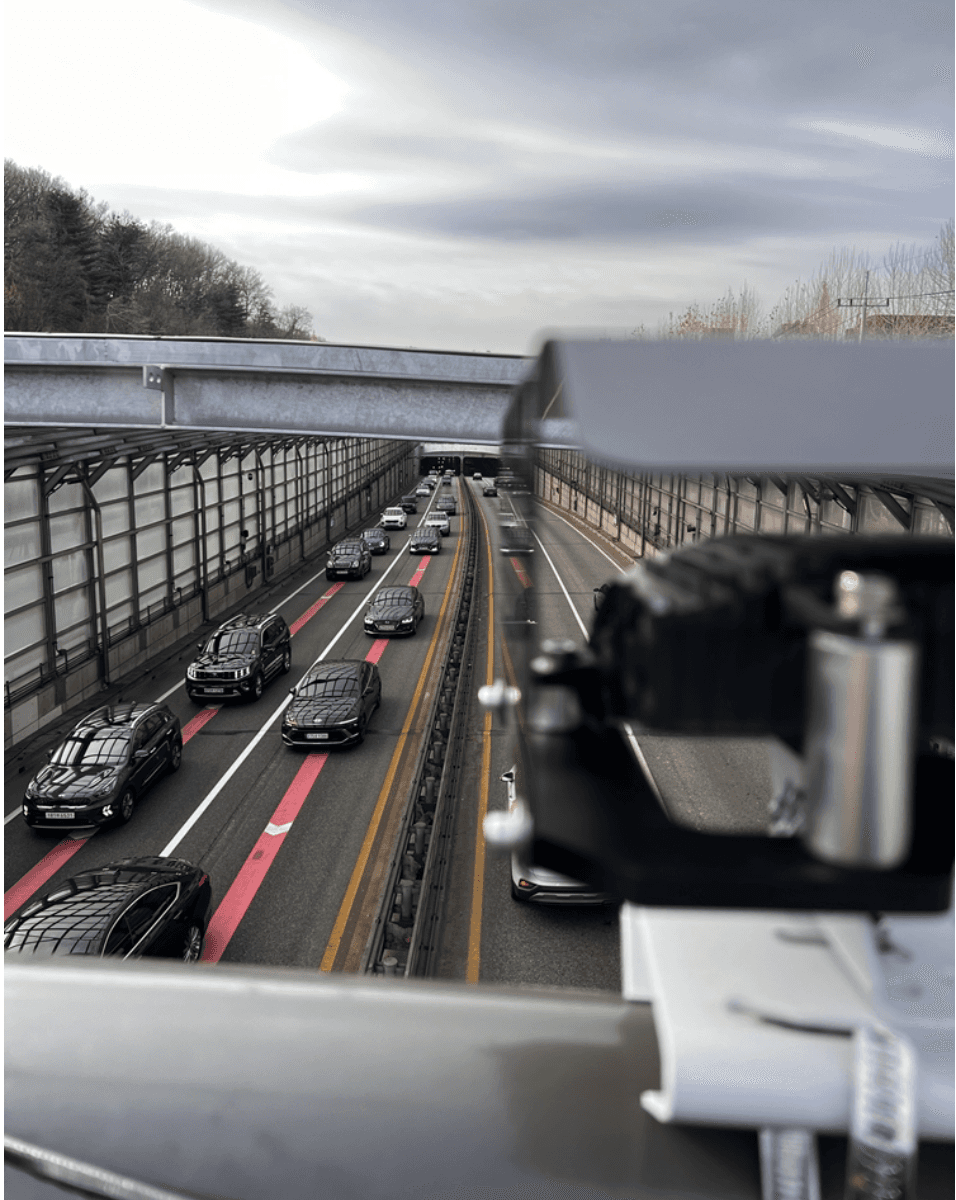
Photo caption: A LiDAR sensor installed in the Guryong Underpass.
Technical Reliability Built on Real Roads
Vueron Technology’s growth has been a history of real-world validation rather than theory. With its headquarters in Korea, the company established branches in Silicon Valley and Munich early on, enabling it to gain an early foothold in global markets. Its projects in the United States in particular became a catalyst for advancing its technology even further. Through cooperation with North American logistics companies to apply LiDAR collision-avoidance systems to large trucks, Vueron was able to analyze how differing road environments and weather conditions affect perception performance.
Through this process, the company built a cyclical structure in which raw field data is collected in real time, learned in the cloud, and then redeployed to vehicles. This experience became the foundation of VueX, which has now emerged as one of Vueron’s key cash cows. By handling everything from data collection and automatic labeling to model training and deployment within a single web-based environment, the platform has brought about a major innovation by reducing LiDAR AI development time from months to just hours.
The LiDAR market is entering a full-scale boom starting in 2026. Vueron is widening the gap with competitors not simply by selling hardware, but by moving first to secure the perception platform that enables the hardware in this vast market to become intelligent.
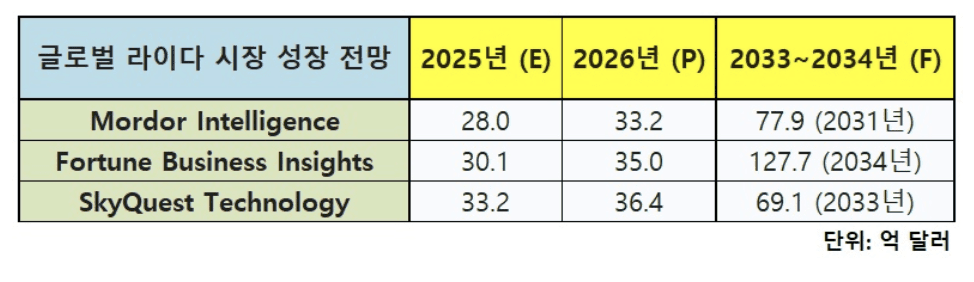
Chart caption: Global LiDAR market growth outlook
Realizing Safety Through Technology … Also Active in the Public Safety Sector
Vueron’s management philosophy centers on the proposition that it must realize safety through technology. CEO Kim Jae-kwang emphasizes that autonomous driving is not merely a means of making driving more convenient, but a welfare technology that can dramatically reduce traffic fatalities and provide freedom of movement to those who have been left in transportation blind spots.
This philosophy is also reflected in the direction of Vueron’s business expansion. The company actively supplies its technology not only for autonomous vehicles but also for public safety applications such as intelligent transportation systems (ITS) and crowd-density management systems.
Recently, Vueron’s VueTwo solution, supplied to airports and major railway stations, has been used to analyze crowd flow and predict accidents without raising the privacy concerns that plague camera-based systems. By leveraging the characteristics of LiDAR, which recognizes only shapes, it prevents personal identification while still carrying out thorough safety management. This is regarded as an excellent example of satisfying both social responsibility in technology and personal data protection, two values that are increasingly important from an ESG management perspective.
An industry expert said, “If the autonomous driving market in the past was a competition over who could build smarter hardware, it has now become a competition over who can interpret that data most efficiently and prove safety through it.” The expert added, “Through its groundbreaking achievement of becoming the first in the world to drive using LiDAR alone, Vueron Technology has demonstrated for itself that its ability to interpret data has already reached the global standard.”
The expert continued, “Vueron’s growth is effectively a textbook example of how Korean venture companies can secure technological leadership in the global tech market.”
Source : https://www.hansbiz.co.kr/news/articleView.html?idxno=828621

